
Here's how web users decide if online content is trustworthy.
The list of signals web users rely on when deciding whether to trust online content or not.
In the order of importance, the trust factors for online content are:
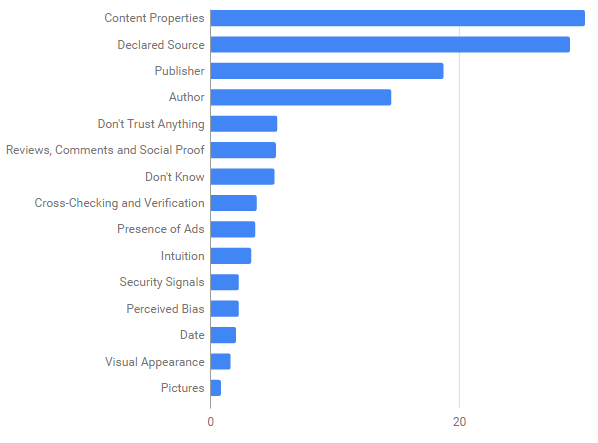
*Nonsensical answers were grouped and removed from the table.
- Content Properties. Title, spelling, grammar, style, language and presence of quick answers.
- Proof. Quotes, links, references and citations.
- Publisher Reputation. Brand, website or publisher reputation.
- Author Reputation. Familiarity with the author and their previous work.
- Social Proof. Peer review, communities, comments and social media.
- Cross-Checking. Facts are often seen as true if found on other web properties.
- Advertising. Presence, quantity and quality of ads.
- Intuition. Some web users use their "gut feeling"when judging trust online.
- Security. Encryption, information safety, authenticity and virus-free environment.
- Bias. Evidence of objective, bias-free information.
- Date. Presence of publishing date. Content age.
- Visual. Aesthetics, design, function, formatting and structure.
- Pictures. Presence of visual media including photos and graphics.
Content Properties
Content quality is the primary factor in trust building online, however it's important to mention that this category represents a cluster of various sub-themes including:- Basics. Includes spelling and grammar.
- Language. Tone, skill and style of writing.
- Answers. Presence clear answers, particularly in the first paragraph.
- Title. Quality of the title and presence of click-bait.
- Usefulness. Overall satisfaction with the quality of information.
- Facts. Factual, research-based writing.
Proof
Our study into what web users think of content links revealed that most see it as a marketing, revenue generating system, but the second most prominent reason was also to supply relevance, context and detail to the story with only 3% of respondents mentioning "Proof and Reference". So here's an interesting twist, we found that despite the negative sentiment towards links on the web, they also play a major trust factor when users evaluate whether to trust a statement made online or not. The key to successful link placement is context.Publisher
The third most important factor in judging content trust online are website reputation signals. These include strong brand familiarity, track record of quality content or being an academic/government resource. When facing unfamiliar publisher for the first time users will look up its credentials by visiting "about us" and "contact us" pages or looking it up in a search engine.Other Signals
Survey Summary Table
| Concept* | % | Answers |
|---|---|---|
| Content Properties | 30.13% | 273 |
| Declared Source | 28.92% | 262 |
| Publisher | 18.76% | 170 |
| Author | 14.57% | 132 |
| Don't Trust Anything | 5.41% | 49 |
| Reviews, Comments and Social Proof | 5.30% | 48 |
| Don't Know | 5.19% | 47 |
| Cross-Checking and Verification | 3.75% | 34 |
| Presence of Ads | 3.64% | 33 |
| Intuition | 3.31% | 30 |
| Security Signals | 2.32% | 21 |
| Perceived Bias | 2.32% | 21 |
| Date | 2.10% | 19 |
| Visual Appearance | 1.66% | 15 |
| Pictures | 0.88% | 8 |