
You Don’t Need a HR Department to Conduct Great Performance Reviews
Performance Reviews are quintessential to the successful operation of any business, but having an official review process in place is sometimes easier said than done. At Dejan SEO, we've introduced formal half-yearly performance review process a while ago. Since we don’t have a HR department,
 Performance Reviews are quintessential to the successful operation of any business, but having an official review process in place is sometimes easier said than done. At Dejan SEO, we've introduced formal half-yearly performance review process a while ago. Since we don’t have a HR department, I was always double-guessing if we’re doing it right. So, for the latest round, we decided to bring in a consultant from Recruitment Coach, who would oversee the process, before, during and after 1-on-1 sessions. They also gave us instructions and feedback during the process and I kept notes so that we’re better prepared when it comes to review time again.
Below is the summary of the process that we went through, I hope you find it useful.
Preparing for Review Meetings
Regular review meetings are vital in ensuring that your employees meet performance expectations and remain satisfied in their roles.
As a general rule, plan for all your performance review meetings at the start of the review period. This will provide you with a larger framework of how performances are managed and is much more beneficial than organising meetings ‘on the fly.’
If there is any reading material, you should distribute this to the employee at least 1-2 weeks beforehand.
The First Review Meeting
During the first meeting, you should set goals and expectations for the employee. You can start these meetings with phrases such as, “thank you for taking the time to attend this review, I really appreciate your…”
At Dejan, we found that this structure worked extremely well for first-time meetings:
Performance Reviews are quintessential to the successful operation of any business, but having an official review process in place is sometimes easier said than done. At Dejan SEO, we've introduced formal half-yearly performance review process a while ago. Since we don’t have a HR department, I was always double-guessing if we’re doing it right. So, for the latest round, we decided to bring in a consultant from Recruitment Coach, who would oversee the process, before, during and after 1-on-1 sessions. They also gave us instructions and feedback during the process and I kept notes so that we’re better prepared when it comes to review time again.
Below is the summary of the process that we went through, I hope you find it useful.
Preparing for Review Meetings
Regular review meetings are vital in ensuring that your employees meet performance expectations and remain satisfied in their roles.
As a general rule, plan for all your performance review meetings at the start of the review period. This will provide you with a larger framework of how performances are managed and is much more beneficial than organising meetings ‘on the fly.’
If there is any reading material, you should distribute this to the employee at least 1-2 weeks beforehand.
The First Review Meeting
During the first meeting, you should set goals and expectations for the employee. You can start these meetings with phrases such as, “thank you for taking the time to attend this review, I really appreciate your…”
At Dejan, we found that this structure worked extremely well for first-time meetings:
- Explain to the employee how the Performance Review process works and what ‘rating’ systems are used (e.g. 1-5 stars). You may also like to describe how performances affect pay/bonuses.
- Clarify details regarding the employee’s job function, duties and general expectations and goals. If possible, these should be related to any measurement programs or models you have in place for the organisation.
- Go through any supporting documents with the employee, such as their job description and/or material related to KPI and goal management. You can also use this time to make any amendments to the job description or KPIs.
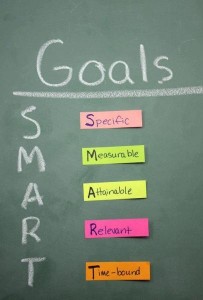 Specific – Each goal and KPI should focus around one, specific objective only. You should make sure there are both technical/skills-based and non-technical/behavioural indicators associated with each goal.
Measurable – How will you measure/assess each goal or KPI? Will measures be quantitative (based on numbers/scores) or qualitative (based on feedback)?
Attainable – Ensure goals and KPIs are achievable and that they encourage the employee to excel and progress.
Relevant – Listen to the employee’s motivations and needs in regards to what they want to achieve or how they see their role growing within the company. Don’t forget to link KPIs to company or department goals/missions too.
Time-based – Your discussion should incorporate both long-term and short-term goals and each should be given a specific “deadline” for review/achievement.
Employee Motivation
At this point, you may also like to discuss what the employee’s motivations are in the role. Motivations can be related to professional development, experience, promotions, culture, career goals and money. Finding out what motivates your employees will allow you to gauge their strengths/weaknesses and can inform the goals and objectives you set for them.
Some empowering questions about motivation that I use include:
Specific – Each goal and KPI should focus around one, specific objective only. You should make sure there are both technical/skills-based and non-technical/behavioural indicators associated with each goal.
Measurable – How will you measure/assess each goal or KPI? Will measures be quantitative (based on numbers/scores) or qualitative (based on feedback)?
Attainable – Ensure goals and KPIs are achievable and that they encourage the employee to excel and progress.
Relevant – Listen to the employee’s motivations and needs in regards to what they want to achieve or how they see their role growing within the company. Don’t forget to link KPIs to company or department goals/missions too.
Time-based – Your discussion should incorporate both long-term and short-term goals and each should be given a specific “deadline” for review/achievement.
Employee Motivation
At this point, you may also like to discuss what the employee’s motivations are in the role. Motivations can be related to professional development, experience, promotions, culture, career goals and money. Finding out what motivates your employees will allow you to gauge their strengths/weaknesses and can inform the goals and objectives you set for them.
Some empowering questions about motivation that I use include:
- How would you like to receive recognition and what would you like to receive for a job well done?
- Who was the best/worst manager you’ve ever worked with? Why?
- What three things will sustain your loyalty and job satisfaction?
- What three things would make you want to leave?
- What three things will most help you improve in the role?
- Appraisals and subsequent Performance Reviews should include:
- A positive reminder of how far they employee has come; you can ask them to perform a self-appraisal in the first instance, before you move on with your review and feedback.
- A review of each goal and KPI and how/if the employee achieved it. You should ask the employee what he/she learned from the process, what was done excellently and what could be improved next time. Use the rating system you have established to evaluate each achievement.
- A discussion about whether any goals, KPIs or general expectations should change.
- A discussion about any negative aspects of the employee’s progress or behaviour. When giving negative feedback, remain honest, clear and professional.
- What can I do to motivate you more?
- How can I be more helpful in regards to your tasks/duties?
- Do you want me to be more involved or less involved with your role?
- How can I contribute to your learning, experience and education on the job?
- If you were in my shoes, what would you change?